I Built an AI Clone Real Estate Content System in 100 Hours — Here Are the Results
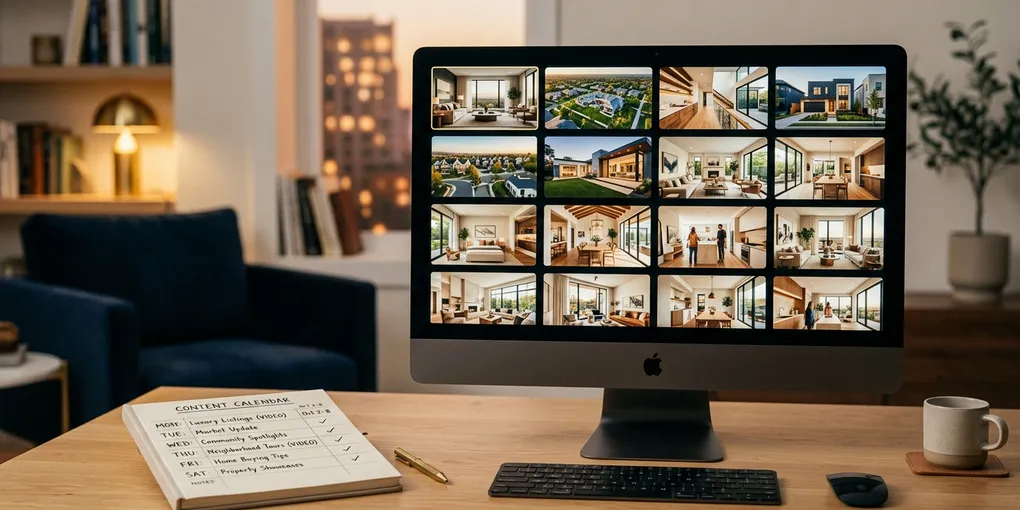
Six months ago I started building an AI clone real estate content system. I wanted to find out whether I could publish consistent video content — home tours, educational videos, short-form clips — without standing in front of a camera every week. After 100+ hours of work, the system generated 6-7 direct leads, a $500,000 offer, and a listing appointment. All from videos where my AI clone did the talking.
This post covers exactly how the system works, the three types of videos I produce, the real analytics, and why I think every agent who wants to scale needs to build their own version of this.
Why I Stopped Filming Myself
Most real estate agents I know have tried content creation. They bought a ring light, set up their phone, recorded a few videos, edited them, posted, got 47 views, and quit. I know because I almost did the same thing.
The problem was never the content ideas. It was the production overhead. Setting up lights, finding a quiet room, getting camera-ready, recording multiple takes, editing — for a full-time agent working with active clients, the time cost is brutal. You’re either showing homes or making videos. Doing both consistently is nearly impossible unless you have a system that removes you from the production process.
That’s what an AI clone real estate content system does. I trained an AI version of my voice and face, built workflows around it, and now my team produces videos using that clone while I’m out meeting clients. The videos sound like me, look like me, and deliver the same kind of market analysis and property walkthroughs I’d do in person.
If you want the full breakdown of the tools I use for this workflow, I wrote a comprehensive comparison on our AI tools page that covers the platforms worth considering.
The Three Types of AI Clone Videos
Not all AI clone content performs the same way. After testing dozens of formats over six months, I narrowed it down to three video types that each serve a different purpose in the lead generation funnel.
Type 1: Narrated AI Home Tours
This is the simplest format to produce. You take listing photos, convert them to video clips using AI, and layer your AI clone’s narration over the visuals. The result is a property tour video where your clone walks viewers through the home — room by room, feature by feature — as if you were doing a personal walkthrough.
Here’s what surprised me about the performance: these narrated tours consistently get 50-60% more views than standard slideshow home tour videos. The same photos, the same listing information, but with a human voice and face attached to the narration. That difference in engagement compounds over time. More views per video means the algorithm shows your content to more people, which means more potential leads seeing your face and hearing your voice.
The production process is straightforward. My team takes the listing photos, generates video clips from them, scripts a brief narration covering the key selling points, runs it through the AI clone, and publishes. I review and approve the final cut, but I’m not spending two hours filming and editing. The entire production happens without me being in the room.
For buyers watching these videos, the experience is closer to having a personal tour than scrolling through static photos on Zillow. They see a real person — my clone, but it reads as me — walking them through the property. That creates a level of connection that a photo slideshow cannot match.
Type 2: Long-Form Educational Videos
This is where the real relationship-building happens, and it’s the format I’m most bullish on for 2026.
Long-form videos — 10 to 20 minutes on topics like market analysis, buyer mistakes, negotiation strategies — give viewers enough time to actually build a relationship with you. Someone who watches a 15-minute video about homes to avoid in Austin has spent more focused time with you than most initial client consultations provide.
I create videos like “5 Homes in Texas That You’ll Regret in 6 Months” where my AI clone delivers the full analysis. Market data, neighborhood insights, specific warnings about property types that are likely to lose value. The content is substantive enough that viewers feel like they’re getting real advice from someone who knows the local market.
These take longer to produce than home tours. The scripting needs to be thorough, the data needs to be accurate, and the AI clone delivery needs to feel natural across a longer format. But the payoff is dramatically different. A viewer who watches 15 minutes of your market analysis walks into a meeting already trusting you. The “know, like, and trust” factor that normally takes weeks of in-person interaction gets compressed into a single video session.
One of my recent clients watched several of my long-form videos before reaching out. When we met in person, there was no awkward getting-to-know-you phase. He already knew my perspective on the Austin market, my approach to negotiation, my communication style. We toured one home together and submitted a $500,000 offer. The trust was pre-built through content.
Type 3: Short-Form Discovery Clips
Short-form videos — 30 to 90 seconds — serve a completely different purpose than the first two types. These are discovery engines. They don’t build deep relationships, but they get you noticed by people who have never heard of you.
I create clips like “5 Tips After 100 Hours Building an AI Clone” designed specifically for platforms like YouTube Shorts, Instagram Reels, TikTok, and Facebook Reels. The beauty of short-form is that one piece of content can be posted across four or five platforms simultaneously. Each platform’s algorithm handles distribution independently, so a single 60-second video gets multiple shots at finding an audience.
The production cost is minimal. Short scripts, quick AI clone renders, simple editing. My team can produce several of these per week without significant effort.
The strategy is layered: short-form content gets discovered by new audiences, those viewers click through to my profile, see longer content, watch a full video, and now they’re in the relationship-building pipeline. Short-form is the top of the funnel. Long-form is what converts.
The Real Numbers
I want to be transparent about the analytics because too many content creators share only highlight reels.
Over the past 28 days on one of my YouTube channels, I generated approximately 1,800 views and 55 hours of watch time. By YouTube standards, those numbers are modest. I used to get significantly more views when the relocation niche was less competitive. The market has shifted, and competition in the Austin relocation content space has heated up substantially.
But here’s what matters more than raw view counts — the quality of leads these videos produce:
- 6-7 direct leads from video content in recent weeks
- One $500,000 offer submitted from a buyer who found me through YouTube
- One listing appointment secured from a seller who couldn’t sell their home through traditional methods and found me on YouTube
- One showing appointment scheduled with an out-of-town relocation buyer
That listing appointment is worth highlighting. The seller had been unable to move their home in the Austin market. They found me on YouTube and asked what made me different from other agents. My answer: I have YouTube channels that reach tens of thousands of ready buyers interested in Austin real estate. I’m the top-ranked creator in my particular niche. If you want access to my audience — a unique distribution channel that Zillow and Realtor.com cannot reach and that other agents don’t have — you need to work with me.
That pitch convinced the seller to sign. The content system didn’t just generate buyer leads; it became my competitive advantage on listing presentations.
Content Strategy Matters More Than Content Volume
Building an AI clone real estate content system is only half the equation. The other half — the part most agents skip — is choosing the right niche and topics.
I learned this the hard way. In 2023, when I first started making videos, I focused on investor content. I thought my analytical background would attract real estate investors. The problem was timing. Interest rates hit 8.2%, bonds were paying 5.5-6% with zero effort, and investors had no reason to buy leveraged real estate when risk-free returns were comparable. I spent 3-6 months creating content for an audience that wasn’t buying.
The lesson: your content strategy needs to align with where actual buyer demand exists, not just what you find interesting to talk about.
For 2026, I’m shifting toward first-time homebuyer content. Renters who’ve been waiting on the sidelines are starting to re-enter the market. I’m creating videos focused on the home-buying process, what to watch out for, how to negotiate in Austin, and common first-time buyer mistakes. The goal is to become the niche authority in that space so that when those buyers are ready, my content is what they’ve been watching for months.
This is where an AI clone system becomes particularly powerful. Because the production overhead is low, I can pivot my content strategy without rebuilding my entire filming setup. New niche, new scripts, same clone, same team, same workflow. The system is flexible enough to follow the market.
If you’re trying to figure out which AI tools work best for different parts of the content creation process, subscribe to the newsletter — I send detailed guides that walk through the specific platforms and workflows.
Why Every Agent Needs a Unique Distribution Channel
The most important takeaway from this experiment isn’t the AI clone technology itself. It’s the concept of owning a unique distribution channel.
Every agent can take good photos. Every agent can do drone shots. Every agent can write listing descriptions. Those are table stakes. What separates you in a listing presentation is having access to an audience that no other agent can reach.
When I tell a seller that my YouTube content reaches tens of thousands of potential Austin buyers — people who are actively researching relocation, who have watched hours of my market analysis, who already trust my expertise — that’s a competitive advantage no other agent in my market can replicate. Zillow can’t provide it. Realtor.com can’t provide it. The agent down the street who bought a billboard can’t provide it.
Your AI clone content system builds this distribution channel for you. Every video is an asset that works while you sleep. It prospects for you, builds relationships for you, and pre-sells your expertise to people you’ve never met. Three months from now, someone watching today’s video may reach out ready to buy. Six months from now, a seller may choose you over ten other agents because they’ve watched 20 of your videos and feel like they already know you.
That pre-built trust is something money can’t buy. It can only be earned through consistent, valuable content — and an AI clone system makes that consistency achievable without sacrificing your actual client work.
Getting Started Without 100 Hours
You don’t need to invest 100 hours to start seeing results. I spent that time because I was building the system from scratch — figuring out the tools, training the clone, developing workflows, and teaching my team. You can shortcut most of that learning curve.
Start with short-form content. It’s the easiest to produce, the fastest to test, and it works across multiple platforms simultaneously. Once you see what topics resonate with your local market, expand into narrated home tours. Once you’re comfortable with the production workflow, add long-form educational content.
The key is consistency over perfection. A video that goes live today is infinitely more valuable than a perfect video you’ll film next month. Your AI clone doesn’t have bad hair days, doesn’t need to find parking at a listing, and doesn’t cancel because a client meeting ran long. It shows up every single time.
I share detailed breakdowns of the tools, workflows, and strategies I use in my weekly newsletter. If you’re serious about building your own AI clone real estate content system, that’s the best place to start. I send the exact workflows, not theory — the actual step-by-step process I use to go from script to published video without touching a camera.
The Bottom Line
100 hours, three video formats, 6-7 leads, a $500,000 offer, and a listing signed. The AI clone real estate content system works — not because the technology is flashy, but because it solves the core problem that kills content creation for agents: time.
You’re not choosing between filming videos and working with clients anymore. The clone handles production. You handle closings. The content library grows while you sleep, building trust with future clients who will reach out weeks or months from now feeling like they already know you.
That’s the real value of this system. Not the AI technology. The compounding relationship equity that consistent content creates — made possible because you finally removed yourself from the production bottleneck.
Liked this article? Get more like it.
AI tools, prompts, and workflows that close deals — delivered in 5 minutes a week. Free, unsubscribe anytime.